
AI adoption is no longer a futuristic concept—it's a present-day imperative reshaping competitive landscapes. Organizations are moving from early experimentation to a more deliberate, holistic integration of artificial intelligence. This shift is driven by the potential for unparalleled gains in efficiency, decision-making, and market agility. However, the path to a fully AI-enabled enterprise is fraught with complexity, requiring a strategic vision that goes beyond mere technology implementation.
This blueprint serves as a guide for leaders, project managers, and innovators seeking to navigate the intricate journey of AI integration. We'll explore the evolution of this transformative technology, break down the core pillars of successful adoption, analyze leading industry frameworks, and, finally, introduce our proprietary methodology, designed to unlock sustainable value and competitive advantage.
The Evolution of AI in Organizations
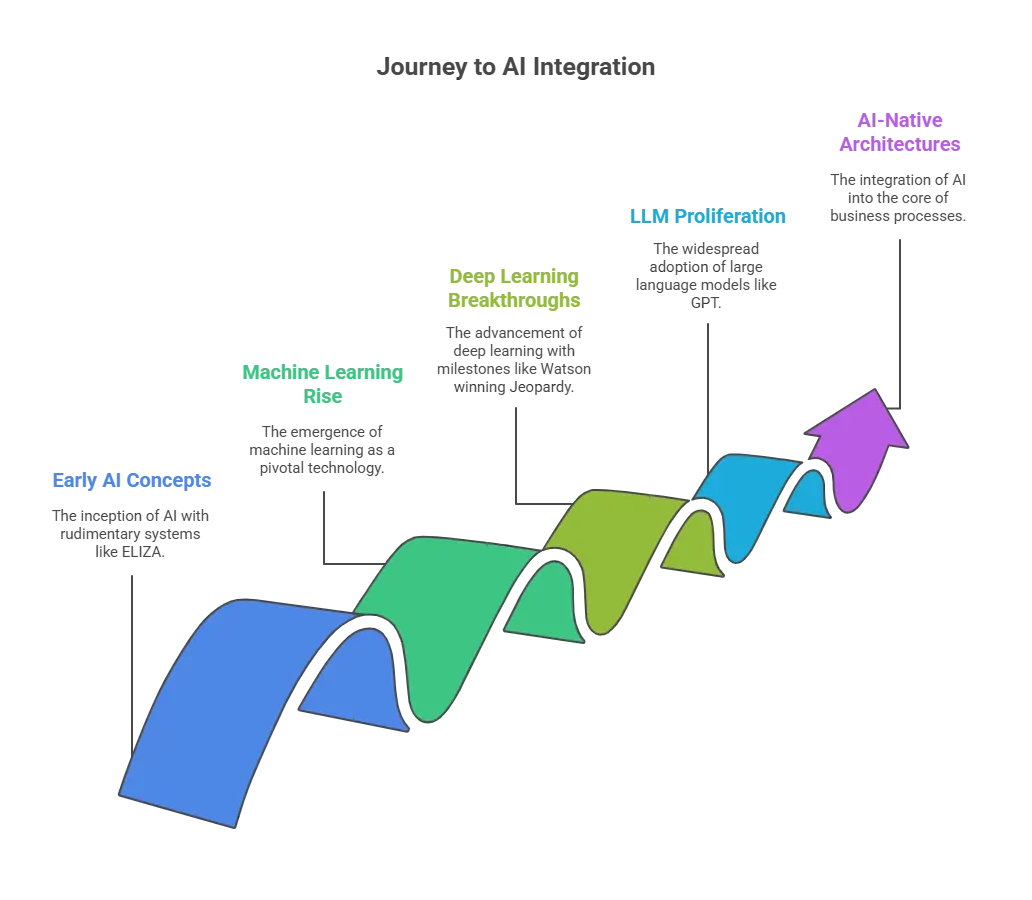
The journey of AI in the corporate world has been marked by distinct phases. Its origins trace back to the mid-20th century with early concepts and rudimentary systems like the ELIZA chatbot, which demonstrated the potential for human-computer interaction. However, these early attempts often led to "AI winters" as the technology failed to meet inflated expectations. The concept of AI largely remained in academic and research circles until the late 20th century.
A significant turning point came with the rise of machine learning, followed by deep learning breakthroughs in the 2010s. This period saw pivotal moments such as IBM's Watson winning Jeopardy and the rapid commercialization of AI in areas like predictive analytics and natural language processing. The real revolution, however, has been catalyzed by the proliferation of large language models (LLMs) like GPT and the democratization of AI tools, making them accessible to organizations of all sizes. This current era is defined by the transition from AI as a specialized tool for niche applications to a foundational technology embedded across the enterprise. The future trajectory suggests a move towards AI-native architectures, where intelligence is not just an add-on but is woven into the very fabric of business processes and products, leading to a new era of human-AI collaboration and augmentation.
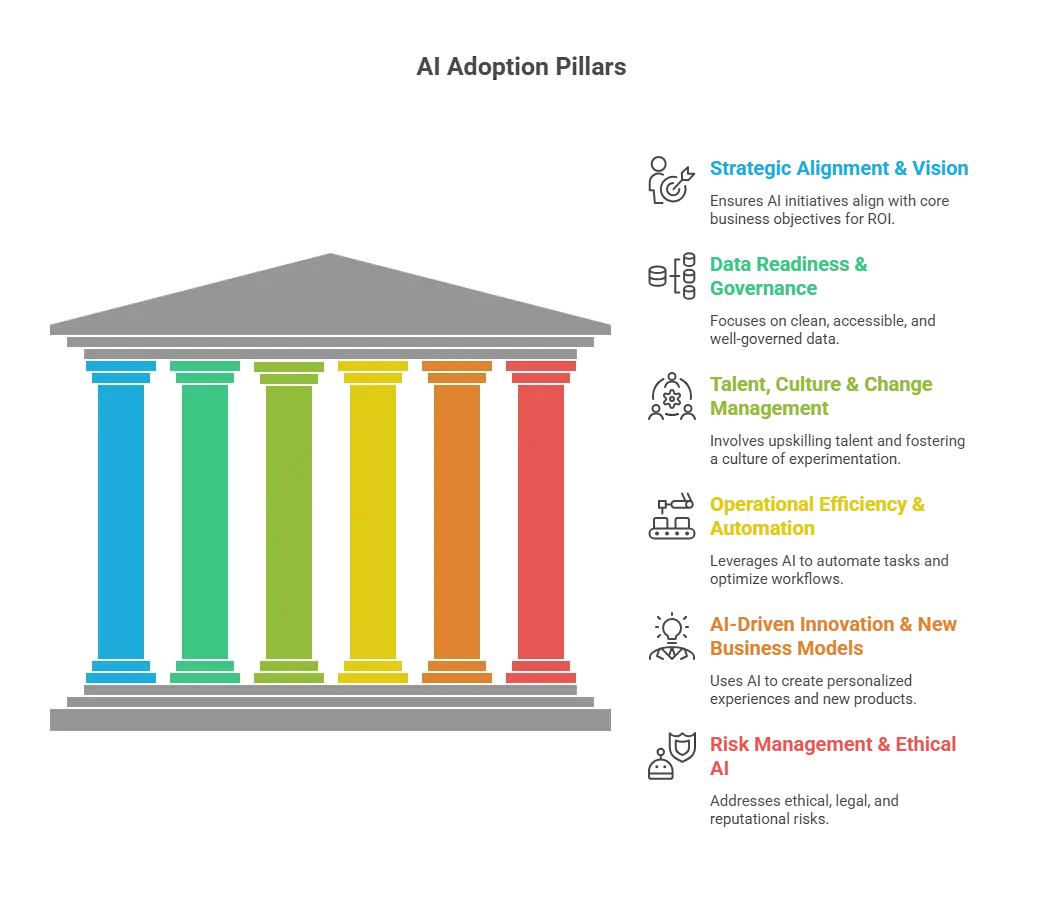
AI Adoption Pillars
Successful AI integration is not just a technological feat—it requires a holistic approach built on several interdependent pillars. Addressing these foundational elements is critical for moving beyond isolated pilot projects to scalable, impactful, and sustainable AI adoption.
1. Strategic Alignment & Vision. The most critical step is ensuring that AI initiatives are directly tied to core business objectives. Without a clear vision, projects can become fragmented experiments with no demonstrable return on investment (ROI). A compelling AI strategy articulates how intelligence will be used to enhance existing business models, create new revenue streams, and generate a defensible competitive advantage. It's about asking, "What business problem are we trying to solve?" before, "What AI tool should we use?"
2. Data Readiness & Governance. AI models are only as good as the data they are trained on. This pillar focuses on ensuring that an organization's data is clean, accessible, and well-governed. This includes establishing robust data pipelines, implementing data quality protocols, and ensuring compliance with privacy regulations. A strong data foundation is the bedrock for any effective AI initiative.
3. Talent, Culture & Change Management. Technology alone cannot drive transformation. Successful AI adoption hinges on people. This pillar involves upskilling existing talent, recruiting new experts, and, most importantly, fostering a culture of experimentation and data-driven decision-making. Change management is crucial for mitigating resistance, ensuring employee buy-in, and helping teams adapt to new ways of working alongside intelligent systems.
4. Operational Efficiency & Automation. This is often the entry point for many organizations. By leveraging AI to automate repetitive tasks, optimize workflows, and enhance operational visibility, companies can unlock significant efficiency gains. Examples include using AI-powered chatbots for customer service, automating supply chain logistics, and using machine learning for predictive maintenance.
5. AI-Driven Innovation & New Business Models. While efficiency is vital, the true long-term value of AI lies in its ability to spark innovation. This involves using AI to create personalized customer experiences, develop entirely new products, and invent novel business models. This pillar is about moving from "doing things better" to "doing better things" and rethinking how an organization interacts with its market and customers.
6. Risk Management & Ethical AI. As AI becomes more powerful, so do the risks. This pillar addresses the crucial need for a framework to manage ethical, legal, and reputational risks. It includes implementing principles for algorithmic transparency, fairness, and accountability. Ensuring that AI systems are explainable and unbiased is not just an ethical obligation but a business necessity for building public trust and avoiding costly mistakes.
AI Adoption Frameworks
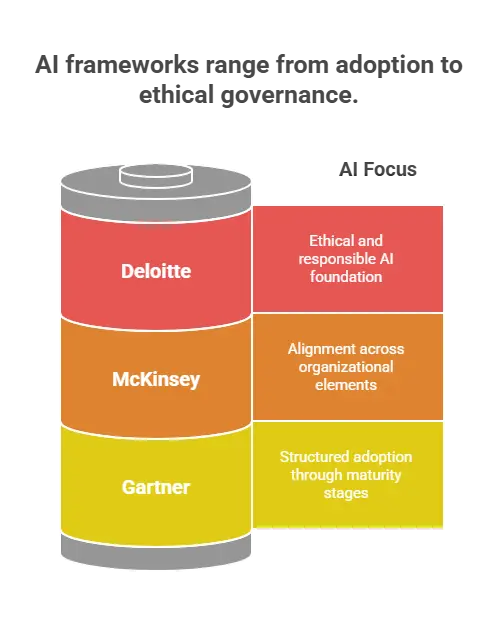
Understanding the landscape of existing methodologies is crucial for developing a sound strategic plan. Major global consultancies have developed their own frameworks, each with a unique philosophy and approach.
Gartner's AI Maturity Model
Philosophy and Principles: Gartner's model is centered on the concept of maturity, suggesting that AI adoption is a journey with distinct, measurable stages. Its core principle is that organizations must progress through these phases in a structured manner, building capabilities and sophistication at each level before moving to the next.
Phases or Components: The framework outlines four key stages:
- Stage 1: Awareness. A basic understanding of AI's potential, with initial research and limited, siloed pilot projects.
- Stage 2: Adoption. Intentional implementation of AI tools for specific use cases to solve known business problems. Data and infrastructure are often still being developed.
- Stage 3: Expansion. AI capabilities are scaled across multiple business units and functions. The organization begins to develop an internal AI platform and a dedicated team.
- Stage 4: Innovation. AI is deeply integrated into the company's DNA. The organization is AI-driven, using intelligence to create new products, business models, and a significant competitive advantage.
Strengths and Applications: This model is particularly useful for C-level executives and leaders who need a clear, objective benchmark to assess their company's current state and plot a path forward. Its phased approach provides a structured roadmap and helps in setting realistic goals and expectations.
McKinsey's AI Transformation Framework
Philosophy and Principles: McKinsey's approach is not a standalone AI framework but rather an adaptation of their well-known 7-S Model, arguing that successful AI transformation requires alignment across all seven elements of an organization: Strategy, Structure, Systems, Shared Values, Skills, Staff, and Style. The philosophy is that AI is not just a technology but a fundamental force that necessitates a company-wide transformation.
Phases or Components: While not a step-by-step methodology, McKinsey identifies five key roles for AI in an organization:
- Researcher: AI for data analysis and insight generation.
- Interpreter: AI for translating data into actionable reports and insights.
- Thought Partner: AI as a collaborative tool to augment human decision-making.
- Simulator: AI for modeling complex scenarios.
- Communicator: AI for enhancing customer and employee communication. Their work on AI also often emphasizes a three-step action plan: get smart, start building today, and develop a proprietary data ecosystem.
Strengths and Applications: The 7-S adaptation is valuable for strategic leaders, as it highlights that a successful AI initiative requires addressing not just the technical aspects but also the organizational culture, skills, and processes. It provides a holistic checklist for enterprise readiness.
Deloitte's Trustworthy AI Framework
Philosophy and Principles: Deloitte's approach is distinct in its primary focus: governance and ethics. Rather than a phased adoption roadmap, their framework centers on building a robust, ethical, and responsible AI foundation. The core principle is that trust is a prerequisite for scaling AI, and an organization must proactively manage the associated risks.
Phases or Components: This framework is not linear but is composed of interconnected components that govern the AI lifecycle. Key principles include:
- Fairness and Impartiality: Ensuring AI systems do not perpetuate bias.
- Transparency and Explainability: Making AI decisions understandable to stakeholders.
- Robustness and Reliability: Ensuring systems are resilient and perform as expected.
- Privacy and Security: Protecting sensitive data throughout the AI lifecycle.
- Accountability: Defining who is responsible for the outputs of an AI system. This framework is applied across the entire value chain, from data collection to model deployment and monitoring.
Strengths and Applications: This model is indispensable for compliance officers, legal teams, and risk managers. It's a critical guide for any organization operating in a regulated industry or one that values its reputation above all else.
Framework | Core Philosophy | Key Stages / Levels | Primary Focus | Strengths | Weakness |
Gartner's AI Maturity Model | Phased progression of capability. | Awareness, Adoption, Expansion, Innovation. | Organizational maturity & capability. | Clear roadmap, good for benchmarking. | Can be overly simplistic, doesn't detail internal processes. |
McKinsey's AI Transformation Framework | Holistic, 7-S organizational alignment. | N/A (focus on strategic roles). | Enterprise-wide integration & strategy. | Comprehensive, links AI to overall business strategy. | Not a step-by-step guide, abstract for tactical teams. |
Deloitte's Trustworthy AI Framework | Governance and ethical foundation. | N/A (focus on principles). | Risk mitigation, ethics, and compliance. | Proactive risk management, builds trust. | Lacks a prescriptive roadmap for adoption; more of a guiding philosophy. |
AI Tools Categories
The burgeoning AI ecosystem offers a wide array of tools, each serving a distinct purpose in the adoption journey:
- General Purpose. These are accessible, user-friendly tools that provide broad capabilities and are often the first point of contact for many teams. Examples include Microsoft Copilot and ChatGPT, which assist with everything from drafting emails and code to summarizing documents. These tools are democratizing AI, empowering individual productivity.
- Platform-Embedded Solutions. Major software vendors are now embedding AI directly into their products. Salesforce Einstein for CRM, Adobe Firefly for creative work, and Monday AI for project management are prime examples. These solutions leverage an organization's existing data and workflows, making integration seamless and providing immediate value by augmenting existing processes.
- Specialized & Custom Platforms. For organizations with unique or complex needs, custom solutions are often the answer. Platforms like Google Cloud AI, Amazon SageMaker, and IBM watsonx provide the infrastructure for building, training, and deploying bespoke AI models. This category of tools is for enterprises that have a dedicated data science team and are looking to build a defensible, proprietary data advantage.

Introducing The Genialprojects Velocity Framework™
Drawing from the strengths of existing models and addressing their weaknesses, Genialprojects has developed a proprietary framework for AI adoption. The Genialprojects Velocity Framework™ is a pragmatic, actionable methodology that bridges the gap between high-level strategy and tactical execution, designed to accelerate your company’s journey from a nascent idea to scaled business value.
Our unique value proposition lies in our focus on the strategic-to-tactical loop. We address the critical needs of both executives (who require a clear business case) and project teams (who require a practical, step-by-step guide for implementation). While others offer high-level strategies or focus solely on a technical maturity curve, our framework is an end-to-end blueprint for delivering tangible, measurable outcomes.
Phase 1: Orient & Blueprint
Objective: To align AI initiatives with strategic business goals and lay a foundational blueprint for success. This phase is about strategic foresight and preparation, ensuring every initiative has a clear purpose and a strong business case.
Key Activities:
- Value Stream Mapping: Identify business functions and processes with the highest potential for AI-driven transformation.
- AI Readiness Assessment: Evaluate the organization's current state across data, technology, and talent.
- Strategic Blueprinting: Develop a detailed roadmap outlining key initiatives, expected ROI, and a phased implementation plan.
Deliverables: Strategic AI Roadmap Document, Business Case & ROI Projection, Executive Briefing Deck.
Phase 2: Govern & Enable
Objective: To establish the necessary infrastructure, governance, and talent to support the AI roadmap. This phase is about building a secure, ethical, and scalable foundation.
Key Activities:
- Data Governance Framework: Establish policies for data quality, security, and access.
- Ethical AI Guidelines: Develop principles and controls to ensure AI systems are fair, transparent, and accountable.
- Talent & Capability Building: Launch training programs for key employees and implement a hiring plan for specialized roles.
Deliverables: Data Governance Policy, Ethical AI Handbook, Skill Gap Analysis & Training Plan.
Phase 3: Pilot & Accelerate
Objective: To execute targeted pilot initiatives, learn, and scale successful deployments across the organization. This phase moves from theory to practice, focusing on agile, iterative execution.
Key Activities:
- Agile AI Pilots: Launch small-scale, high-impact projects with clear success metrics.
- Performance Monitoring: Implement a system to track the performance and business impact of AI models.
- Value Acceleration: Systematically scale successful pilots into full-scale operational deployments.
Deliverables: Pilot Project Case Study, Performance Dashboard, Scaling Playbook.
Phase | Objective | Key Activities | Deliverables |
1. Orient & Blueprint | Strategic alignment & foundational planning. | Value Stream Mapping, Readiness Assessment, Strategic Blueprinting. | AI Roadmap, ROI Projection, Executive Deck. |
2. Govern & Enable | Establish infrastructure, governance, & talent. | Data Governance, Ethical AI Guidelines, Talent Building. | Governance Policy, Ethical Handbook, Training Plan. |
3. Pilot & Accelerate | Execute, learn, & scale initiatives. | Agile AI Pilots, Performance Monitoring, Value Acceleration. | Pilot Case Study, Performance Dashboard, Scaling Playbook. |

Free Organizational AI Readiness Self-Assessment
Autoevaluación de Preparación Organizacional para la IA gratis
Key Takeaways
The adoption of AI is a complex, multifaceted journey that requires more than just technological prowess. A successful approach demands a clear, strategic vision, a robust data foundation, a culture of change, and a meticulous focus on risk and ethics. While frameworks from leading consultancies provide valuable perspectives on maturity, strategy, and governance, a truly effective methodology must integrate these concepts into a single, actionable blueprint.
The Genialprojects Velocity Framework™ is designed to do just that, offering a structured, end-to-end approach that translates strategic intent into tangible business value. It is the roadmap for organizations seeking to navigate the hype and truly embed AI into their core operations, not just to survive, but to thrive in the new, intelligent economy.