
We are at a pivotal moment in the history of innovation. The rise of Artificial Intelligence (AI) isn’t just another technological trend; it’s a fundamental shift, reshaping the very fabric of how we design, develop, and deliver products. From startups to multinational corporations, every organization is facing a stark choice: embrace AI to build a new product paradigm or risk being left behind. This article will explore how AI is not merely an auxiliary tool but a core strategic partner that transforms the entire product lifecycle, from initial ideation to post-launch optimization. We’ll delve into the specific ways AI-driven methodologies create a competitive advantage, enabling teams to build more intelligent, user-centric, and commercially successful products.
The shift is profound. For decades, the product development process has been a series of sequential, often linear, steps. The "waterfall" approach, while organized, was rigid and slow. The "agile" revolution introduced much-needed flexibility and speed. Now, AI is ushering in a "proactive" paradigm—one where systems can anticipate needs, automate complex tasks, and generate novel solutions autonomously. For C-level executives and strategic leaders, this translates to a faster time-to-market, significant cost reductions, and the ability to unlock previously unattainable insights into customer behavior. For product and project managers, it means a more streamlined, data-rich workflow that frees up teams to focus on high-value, creative work.
The Product Lifecycle
The conventional product lifecycle typically involves a sequence of phases: discovery, ideation, design, development, launch, and post-launch. Each phase has its own set of challenges—from the uncertainty of market research to the inefficiencies of manual testing. This traditional model, even when executed with the best agile practices, is often reactive, responding to market feedback and internal data after the fact.
This is where the traditional model shows its limitations. It relies heavily on human intuition and manual processes, which are prone to bias, error, and slowness. Data analysis, while crucial, is often retrospective. Teams spend a great deal of time and effort in repetitive tasks, such as generating endless mockups, manually writing boilerplate code, or poring over QA reports. This leaves little room for the deep, strategic thinking necessary for true innovation.

How AI Is Transforming Product Design and Development
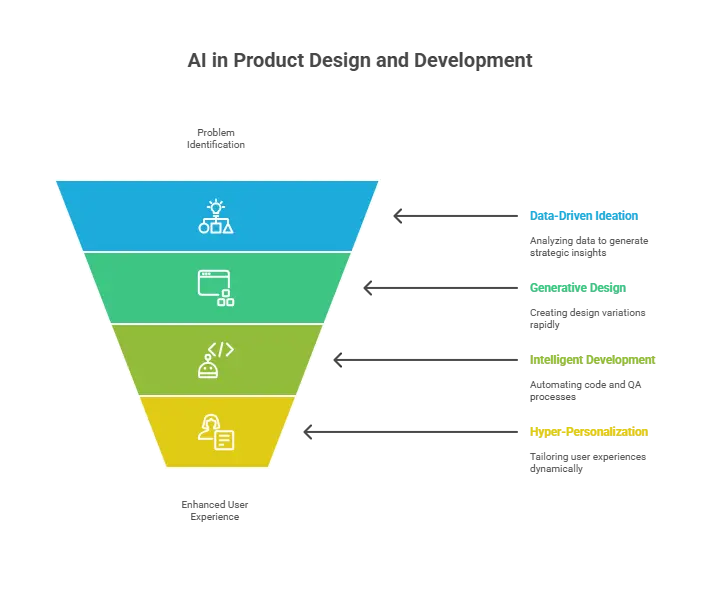
Data-Driven Ideation & Strategic Intelligence
In the past, generating new product ideas was a mix of market research, brainstorming sessions, and educated guesswork. Today, AI-powered tools can analyze vast datasets—including social media trends, search queries, customer feedback, and competitor actions—to identify unmet market needs and emerging opportunities with a speed and accuracy a human team cannot match. This allows product strategists to move from guesswork to strategic intelligence.
AI engines can generate comprehensive market reports, segment user personas based on actual behavior, and even predict the potential success of different features before a single line of code is written. This data-driven approach dramatically reduces the risk of pursuing a non-viable idea and ensures that the strategic focus is aligned with real-world demand.
Generative Design & Rapid Prototyping
Beyond mere aesthetics, these systems can generate functional prototypes and mockups, complete with user flows and interactive elements, based on simple text descriptions. This capability accelerates the prototyping cycle from weeks to hours, allowing for rapid A/B testing and user feedback collection. The speed of this process means teams can test more hypotheses and iterate more aggressively, resulting in a more polished and user-friendly final product.
Intelligent Development & QA Automation
The development phase has always been a bottleneck. Writing code, debugging, and ensuring quality are complex tasks that require significant time and resources. AI is now an invaluable partner, assisting developers in multiple ways. AI-powered code assistants can auto-complete code snippets, suggest functions, and identify potential bugs in real-time. This not only speeds up the development process but also improves code quality and consistency.
Furthermore, AI-driven quality assurance (QA) tools can automate the creation and execution of test cases, running exhaustive checks on a codebase in a fraction of the time it would take a human team. These systems can learn from past defects, predict where new bugs are likely to occur, and even automatically fix some issues. This level of automation significantly reduces the QA cycle and ensures a more stable and reliable product at launch.
Hyper-Personalization & Enhanced User Experience
This level of personalization creates a stronger connection between the user and the product, leading to higher engagement, increased customer satisfaction, and lower churn rates. It also provides a continuous feedback loop, allowing the product to evolve and improve organically based on how real people interact with it.
AI for Strategic & Operational Excellence
The impact of AI extends beyond the tangible product itself, reaching deep into the operational and strategic layers of an organization. By integrating AI across the product lifecycle, organizations gain a powerful new lens for decision-making and a set of tools for enhancing operational efficiency.
One of the most significant benefits is predictive analytics. AI can analyze historical project data to forecast timelines, estimate resource needs, and identify potential risks before they escalate. This capability allows project and product managers to be more proactive and to allocate resources more efficiently, ensuring that initiatives stay on track and within budget.
Moreover, AI can automate routine, low-value tasks like reporting, stakeholder communication, and administrative work. This frees up skilled talent to focus on what matters most: innovation, creativity, and strategic problem-solving. This shift in focus not only improves productivity but also boosts team morale and job satisfaction.
Ethical AI & Trustworthy Governance
As AI becomes more integral to product development, the discussion around ethics and governance moves from a theoretical exercise to a practical necessity. Products built on AI models must be fair, transparent, and secure. A lack of focus on these principles can lead to reputational damage, legal liabilities, and, most importantly, a loss of user trust.
To mitigate these risks, organizations must implement a Trustworthy AI framework that governs the entire lifecycle. This includes ensuring data privacy, auditing algorithms for bias, and maintaining explainability so that the decisions made by the AI can be understood by humans. Building this ethical foundation is not just a moral obligation; it is a critical component of a sustainable, long-term competitive strategy.

AI Tools for Modern Product Management
The market is flooded with tools that promise to transform product development. Here is a curated list of leading AI-powered tools, categorized by their primary function, that every modern product team should consider.
Ideation & Strategy Tools
ChatPRD: A natural language processing tool that transforms simple prompts into detailed product requirements documents (PRDs). This dramatically accelerates the initial documentation phase.
Amplitude: An advanced product analytics platform that uses machine learning to identify key user behaviors and predict which features will drive the most engagement and retention.
Aha!: An AI-integrated roadmap and strategy tool that uses predictive models to suggest feature prioritization based on business goals and user feedback.
Generative Design & Prototyping Tools
Uizard: A design tool that can turn hand-drawn sketches or screenshots into high-fidelity wireframes and prototypes in seconds using AI.
Galileo AI: This platform generates full UI designs and interactive mockups from simple text descriptions, allowing for rapid ideation and validation.
Midjourney & DALL-E: While often used for artistic purposes, these generative AI tools are invaluable for creating visual concepts for branding, marketing materials, and initial product interface ideas.
Development & QA Tools
GitHub Copilot: An AI-powered code assistant that suggests code, entire functions, and even test cases in real-time, significantly accelerating the development process.
Snyk: A security platform that uses AI to scan code for vulnerabilities and automatically suggest fixes, ensuring security is baked into the development lifecycle.
Testim: An AI-powered QA tool that automates the creation and maintenance of end-to-end tests, learning to adapt to UI changes and reducing the need for manual updates.
Go-to-Market & Post-Launch Tools
HubSpot: The AI-integrated CRM helps teams create personalized email campaigns, automate lead qualification, and predict which customers are most likely to convert.
Typeform: The AI-powered survey builder allows teams to gather targeted, qualitative feedback from users more efficiently, informing post-launch optimization.
Segment: A data platform that uses machine learning to unify customer data, enabling hyper-personalized communication and a more holistic view of the customer journey.
Continuous Improvement Tools
Zeda.io: A product management platform that unifies various data sources, from user feedback to analytics, to provide AI-driven insights on what to build next to maximize growth.
Jira Product Discovery: A tool that uses AI to identify opportunities and insights from customer feedback, helping teams prioritize what matters most.
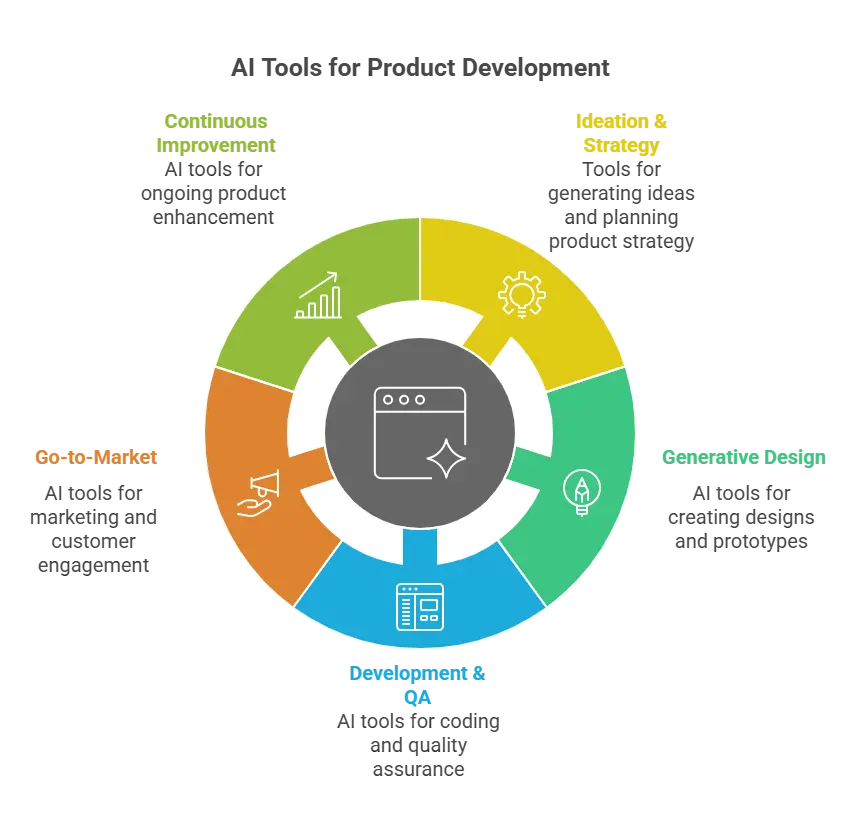
Here is a table summarizing the use of AI across the product lifecycle:
Product Lifecycle | Core Pillar | Key Activities | Example AI Tools |
Ideation & Strategy | Data-Driven Ideation & Strategic Intelligence | Analyzing market trends and user feedback; identifying unmet needs; generating data-driven personas; predicting feature success. | ChatPRD, Amplitude, Aha! |
Design | Generative Design & Rapid Prototyping | Creating multiple design variations; generating high-fidelity mockups from sketches or text prompts; accelerating the prototyping cycle. | Uizard, Galileo AI, Midjourney |
Development | Intelligent Development & QA Automation | Assisting with code generation and completion; identifying and fixing bugs; automating the creation and execution of test cases. | GitHub Copilot, Snyk, Testim |
Post-Launch | Hyper-Personalization & Enhanced UX | Tailoring the user experience to individuals; providing real-time content and feature adjustments; analyzing user behavior for continuous improvement. | HubSpot, Typeform, Segment |
Continuous Improvement | Operational & Strategic Excellence | Automating reporting and low-value tasks; using predictive analytics to forecast timelines and mitigate risks; unifying data from various sources to guide next steps. | Zeda.io, Jira Product Discovery |
Key Takeaways
The integration of AI into product design and development is no longer a future-state aspiration—it's a present-day imperative. For leaders, the value proposition is clear: AI enables faster time-to-market, lowers costs, and provides a powerful competitive advantage. For project and product managers, it means a streamlined, data-rich, and more creative workflow.
The core message is this: AI should not be seen as a replacement for human talent but as an accelerator. It automates the mundane, amplifies creativity, and provides the strategic clarity needed to build successful products in a hyper-competitive market. The organizations that embrace this new product paradigm will be the ones that lead their industries and redefine what’s possible.